But take a look anyway, if you have an interest in process improvement in hospitals. This is a collection of my best posts on this topic.

Sunday, February 23, 2014

This is not my main blog

Hi and welcome!

You can find my main blog here.

I have gradually copied posts related to transparency and Lean process improvement to this blog to serve as an archive and resource to people in hospitals who might want to review the experience at Beth Israel Deaconess Medical Center and other hospitals and apply lessons to their own institutions.  (You can also search "Lean" and "transparency" on my main blog and find most of these, but the search engine is not always complete, so you might find this a more useful place to review those posts.)

I've also included stories from training programs I've conducted around the world on this topic.  What a pleasure it has been to meet thoughtful and well-intentioned people in other countries who are interested in enabling their hospitals to become learning organizations.

Our early version of Lean in the Boston hospital was called BIDMC SPIRIT, so you will see a number of blog posts that refer to that.  We came up with the concept of SPIRIT in November of 2007.  All of the stories during the "SPIRIT" era had the logo atop, to provide a touchpoint for our staff.  I've left some, but not all, of those logos on these reprints to give you a sense.  Eventually, by July of 2009, we let SPIRIT die away as a program "brand," but the lessons we drew from that stage in our institutional development were extraordinarily helpful as we rolled out a philosophy more directly based on Lean principles.

People often ask me how many staff members read my blog during the period covered by many of these posts.  It is impossible to tell exactly, but the likely range is between 1500 and 2000 each day, out of the 6000+ FTEs and 900 doctors on staff.  Some people regularly went to the blog link daily, others subscribed through Feedburner or another aggregator service, some read it on Facebook or Twitter, and others were referred to it by the clipping service published electronically each day by our media services department.  I know, also, that when a specific staff member was mentioned in a blog post, s/he would circulate it widely to family, friends, and co-workers.  This, in turn, led many people to send me story ideas about programmatic successes and setbacks, whether in clinical care or logistical or administrative arenas.  It is hard to overstate the importance of this medium as a leadership, team-building, and institutional communications tool; but a very important aspect of that was that I wrote the posts myself, keeping them current and in my own voice.

But blogging is really not the main point here.  What you see documented is a consistent and decided institutional commitment to transformational change.  It takes a long time and with constant reinforcement from the top folks to fight inertia and entropy and build sustained momentum for this kind of change.  While the senior management has to work really hard to make this work, my personal involvement and interest as CEO and that of the Chiefs was essential.

Another lesson is that personalizing the stories of success and setbacks is extremely important.  You cannot overdo the recognition of individuals, whether formally or informally.

Finally, this approach really works on many dimensions of quality and efficiency, as Steve Spear, John Toussaint, Gary Kaplan, Jim Conway, Bruce Hamilton, Jim Womack, John Shook, Peter Pronovost, Brent James, Mark Graban, Jeff Thompson and the others say.  If there is any path for a general hospital or academic medical center through what is coming down the pike in terms of government and private payer revenue restrictions, and demands by the public for more personalized medical care, this is it.  The attached scatter diagram from The Leapfrog Group is one indication of the kind of results that are possible.

(I have not transferred all the many thoughtful comments from these blog posts.  You will need to go back to the originals to read those.)

I have also transferred a blogroll here of useful resources in this field.  You will find some of the world's experts listed therein, but also real-life people reporting on the work in their hospitals.

Best of luck to you as you make health care safer, higher quality, and more efficient!

Thursday, February 13, 2014

Lean-ing nicely in Den Bosch

I had a chance today to visit one of my favorite hospitals, Jeroen Bosch Ziekenhuis in the Netherlands, and spend time with a number of managers who have been exploring a wider application of the Lean process improvement philosophy.  Frans van de Laar, who runs the blood and urine laboratory, recently introduced one of the simplest and most effective examples of standard work, a morning huddle with the staff who collect the daily flow of samples from inside an doutside of the hospital.


You see Frans here with the white board, around which the staff huddles each day.  After talking about projected workload and staffing responsibilities, one component of the huddle (seen below) is to identify a problem of the week that the group will attempt to solve or a situation which they will attempt to improve.


Below that item, the group decides on an inspirational slogan for the week.  This week is was: Treat a patient like you would want yourself to be treated.

Frans was pleased to note that the huddle has changed a bit since he introduced it, with comments and suggestions from the staff being the impetus for modifications.  Beyond the more serious changes, there was the addition of this humorous priority item in the huddle summary:  Friday + [pictured] coffee and apple pie with ice cream!


Another item adopted by Frans and his team is this voluntary assignment board for minor tasks that need to be done around the lab.  Items are coded by whether they need to be done monthly, quarterly, half-yearly, or on an ad hoc basis and put in the left-hand slots. When a person has a lapse in regular lab work, s/he can volunteer to do the job.  Once finished, the tag is moved to the right-hand side, with notes documenting when it was completed.


One can imagine the alternative, spending time assigning people and monitoring their compliance with these items, possibly creating resentment at being assigned humdrum tasks.  Instead, people volunteer during their slow work periods and feel a sense of contribution to the team effort.

These two examples demonstrate that Lean is a state of mind and a philosophy:  Small improvements, engaged front-line staff, and a manager who views his/her job as one of empowerment and service to the team.

Wednesday, February 5, 2014

Lean hits the soaps

I now have total confidence that Lean process improvement has arrived for real and will soon be adopted in hospitals throughout the world.  The source of my confidence?

Watch this clip from this extremely popular, UK hospital-based soap opera, Holby City.  The new young protagonist, Raffaello “Raf” di Lucca, is a highly driven registrar who is also (tah dah!) a Lean process improvement adherent.

Hereford's Daniel Jones, founder and chairman of the Lean Enterprise Academy--which is "dedicated to pushing forward the frontiers of Lean and to spreading Lean to every kind of organization"--is finally getting his way!

Watch this clip for proof! (You just need to watch less than a minute.)
 

Friday, January 10, 2014

Lean is where you make it happen

I've been meaning to write about this for several months--ever since attending GBMP’s Northeast Shingo Prize Conference this past fall. Short version:  You never know where you will see a superb example of process improvement. Read more for the details below.

The Center for Comparative Medicine at Massachusetts General Hospital has a mission of providing "the highest quality laboratory animal husbandry and veterinary services to MGH investigators and to ensure that all research animals at MGH are maintained and used in accordance with pertinent laws, regulations and accreditation standards."  This is one of over 80 core facilities at Partners HealthCare System which are in place "to bring state-of-the-art instrumentation, methodologies and expertise crucial to the promotion of research on our campuses and beyond."

More specifically, the CCM works to:

(1) provide reliable, affordable, and responsive laboratory animal care and research services to MGH investigators in pursuit of scientific knowledge and medical breakthroughs for patients and their families;
(2) avoid or minimize pain and distress in animals under our care;
(3) maintain a fulfilling, respectful, and safe workplace for our employees.


The CCM has extensive facilities, including ventilated and static cages and racks, autoclaves, tunnel washers, rack washers, bedding dispensers, automatic watering (Edstrom), biosafety cabinets, cage changing stations.  Services offered include procurement, husbandry, training, technical, import/export, quarantine, pathology, breeding, veterinary consulting, and customized research services to the MGH research community.


Hardly a place to find adherents to the Lean process improvement philosophy?  No way.  Meet Gerard Cronin, the "Kaizen Promotion Manager" at the CCM. As noted in this article by Bruce Hamilton:

CCM has been on its Lean journey for 8 years, and has adapted Lean tools and methods in novel ways to service their 5000 customers as efficiently as possible with a staff of 130 employees.

The results are stupendous, as seen in the accompanying summary.


Further:

As a pioneer in Lean management in Biomedical Research, CCM conducts Lean Tours, trainings and seminars to help accelerate the healthcare industry in the development of new therapies against disease.  

At the Shingo conference's "Lean Lounge," many of us were drawn in by a kooky display of dangerous animals and props. Gerry and his able partner Julieanne Brandolini showed us the innovative pedagogical tools they use in their instructional sessions.  They have created a "Lean Starter Kit" and other kits that teach people the standard work that should be in place in various circumstances.

Many conference attendees dropped by the display and stayed on for some time to learn from the good-natured presentations offered by Gerry and Julieanne. As Bruce noted in the article, "The theme of CCM’s 2013 Lean Lounge booth was 'if we can do it, anybody can.'"

True enough, but the leadership has to be in place to make it happen.  This was one shining example of such leadership.

Tuesday, December 17, 2013

On learning organizations

Please check out this new article I wrote for the Athenahealth Leadership Forum.  The lede:

A colleague once said, “Every plan is excellent, until it’s tested. It’s execution that’s the problem.” And so it is. 

Excerpts:

Project advocates enter every endeavor with a theory of the case, a vision of how things should be. But, as my late colleague Donald Schön noted, reflective practitioners are constantly reviewing the evidence to modify their framework in response to reality.

Lean organizations understand that there is no group of central planners clever enough to design an optimum complex process. Lean leaders do not lack for a strong purpose—indeed audacious goals are favored—but neither do they lack humility. 

Lean and other similarly designed organizations can only exist where the senior leadership is a strong advocate for the proposition that reflective practice is the best way to achieve outstanding performance for their customers. The leaders of such organizations embed that modesty and reflection in every aspect of their lives.

Thursday, December 12, 2013

Oatmeal at IHI: The sequel

I never thought that I would be compelled to write another post about the manner in which oatmeal is served at the IHI Annual National Forum at the Marriott World Center in Orlando.


Let me take you back to the original posts from 2010: 1, 2, 3, 4.  Short version: The ladles (see above) provided to guests on the breakfast buffet were too large relative to the bowls, so oatmeal was being spilled all over people's hands and their bowls.  


Unsanitary and messy work-arounds were developed by the guests (like using the tea cup seen above.)  I wrote a blog post about the issue, and the hotel responded by eliminating self-service and assigning staff to serve oatmeal at several stations, providing them with slightly smaller ladles.

Now, three years later, I stopped by an oatmeal station and noticed that the ladle used by the server was still too large relative to the bowl size. So even with an experienced server, the oatmeal often spills over the edge of the bowl onto the hand of the server and the outside of the bowl.  The server then has to use a small towel to clean off both the hand and the bowl.

I say, sympathetically, "That would be easier with a smaller ladle."

Response, "These are the smaller ladles. We use them instead of the regular ones when this group [i.e., IHI] is here.

"You mean you use bigger ones when there are other groups here?"

"Right."

I'm speechless.

Tuesday, December 3, 2013

MVP is a most valuable principle

A few weeks ago, I wrote about the tendency of many start-up companies who try to sell their wares to hospitals to ignore the needs of the various constituencies and therefore fail to make sales.  I concluded:

It is possible to sell great new ideas to hospitals, but they need to satisfy the interests of several constituencies in those organizations.  They must improve the work flow of the staff on the floor and units, making day-to-day life easier and not harder. They must improve the safety and quality of care, but in a manner that does not expose the hospital to greater liability: Indeed they should help reduce liability. Finally, they should demonstrate cost savings and be priced in such a manner as to allow the hospital to show cash flow improvements rather than be a drain.

I was reminded this week by Caren Weinberg, senior lecturer of invovation and entrepreneurship at Ruppin Academic Center in Israel, that even this prescription is not necessarily going to result in a successful product roll-out.  The element that I neglected to mention is the Lean concept of minimum viable product.  Taking off on the practice of PDCA (plan, do, check, act) cycles, Ash Maurya notes that "the basic idea is to maximize validated learning for the least amount of effort. After all, why waste effort building out a product without first testing if it’s worth it?"

Coincidentally, this message was reinforced at an MIT Enterprise Forum at Tel Aviv University, where Wix founder & CEO Avishai Abrahami was providing advice to entepreneuers.  Here's one of his slides:


Over time, he explained, the firm can add incremental features and improvements, all the while testing them with customers.


The alternative approach that I have seen is for a firm to spend inordinate amounts of time and effort designing a spectacular technological fix to a series of problems without testing early concepts or prototypes against customers' needs and wants.  It enters the market with a perfectly engineered product, only to discover that it is off track from what the market demands. Having depleted the company's capital, it falls into a financial hole and has trouble digging out.

Thanks to Caren for the reminder that MVP stands for a "most valuable principle!"

Monday, December 2, 2013

Joining Lean practictioners in Israel

Many thanks to Boaz Tamir, head of Israel Lean Enterprise (part of the Lean Global Network), for an invitation to present at a session for a number of businesses that are involved in adopting the Lean process improvement philosophy in their organizations.  Examples included Intel, the Strauss Group (food and beverage supplier), Bank Hapoalim, and yes (satellite broadcasting.)  The attendees were intrigued with the lessons from my book Goal Play! about how to create learning organizations.


I was honored to share the stage with Micha Popper, from Haifa University, who studies and teaches about leadership.  He told a particularly apt story about how the Israeli Air Force improved their learning process.  Years ago, after the missions, the pilots would sit around and tell each other stories about what had happened during their flights. Later, when technology had improved to document the actual flight conditions and history of each flight, their stories were bolstered by actual data.  The debrief sessions that resulted were much more accurate. More to the point, the flight teams–who previously had a natural tendency to hide or forget their mistakes–became much more open about disclosing their errors, comparing them one with the other, and then learning from the experience.  The result was a documented improvement in pilots’ abilities.

Sunday, November 24, 2013

Exploring Lean in Tel Aviv

A colleague and I are in the midst of an introductory training session about the Lean process improvement philosophy at Sheba Medical Center on the outskirts of Tel Aviv, Israel.  We were invited by Dr. Eyal Zimlichman, head of quality management for the hospital (seen here with Jessica Livneh, head nurse of the oncology outpatient unit.) As is often the case, we find highly committed, engaged staff and managers facing the usual assortment of hospital management problems. Their interest in the opportunities offered by Lean is palpable, but part of our job is to explain that adoption of this philosophy takes extensive time and effort. Our hope is that this session will give them a taste of the possibilities so they and their leaders can make a more informed decision about the path forward.

We were honored to be joined by Boaz Tamir, Israel's Lean guru.  You see him here with (from right to left--appropriately!) Yoav Shalem (pharmacist); Dr. Einav Nili Gal-Yam (head of the oncology outptient unit); and Miriam Adam (director of pharmacy services).

Friday, October 25, 2013

Pigs in service to America

The NSA probably knows this already, so I think it is all right to spread the word.

I noticed in my blog statistics that someone from the Department of Homeland Security was looking at a series of my favorite Lean training blog posts.  They are about drawing a pig.  Hey they are: Part 1, Part 2, and Part 3.

But I wondered what led them to these sites.  Well, the statistics app suggests that they came to it via a process improvement website from the UK.

However they got here, I am pleased, and I hope they find the exercises useful. I hope someone lets me know someday if the training will be used. And where? At the airports?


Monday, October 7, 2013

Lean good news from the Midwest

I received this announcement recently.  This sounds like an interesting and useful venture.

The ThedaCare Center for Healthcare Value and the Ohio State University Fisher College of Business are excited to announce the creation of the Center for Lean Healthcare Research. This new center will be housed at Fisher and will build the body of research on the emerging trend of process improvement in healthcare.

A press release elaborated:

As health care organizations continue to seek ways to improve patient care quality and reduce costs, the ThedaCare Center for Healthcare Value and The Ohio State University Fisher College of Business are partnering to build the body of research on the emerging trend of process improvement in healthcare. The organizations have announced the creation of the Center for Lean Healthcare Research, to be housed at Fisher. This collaboration will focus on studying and documenting how the Lean methodology is producing lasting change in hospitals around the nation. Sharon Schweikhart, associate professor and director of the Master’s in Health Administration program at Ohio State, has been appointed director of the center.

The ultimate goal of the Center for Lean Healthcare Research is to create a peer- reviewed body of research that elevates the profile of these Lean health care practices and better equips hospitals and other organizations to deploy them.

Tuesday, September 24, 2013

A solution to clutter

#GBMP1 Sometimes unexpected proposed countermeasures to problems called out during Lean process improvement efforts come up.  Look at the one proposed here on a suggestion form!  While Lean envisions countermeasures as temporary or iterative or interim solutions to problems, I don't think even the most creative of Lean experts would have come up with this one--even for the short term.


Thanks to Gary Peterson at O. C. Tanner for this humorous example.

Notes from a Lean conference

#GBMP1 I'm currently attending the 9th Annual Northeast Shingo Prize Conference presented by GBMP, a non-profit that is engaged in Lean educational programs.  Entitled, "True North: Set the Course, Make Waves," the conference began with a short introduction by GBMP's president, Bruce Hamilton.  Regular readers will recognize Bruce as the star of Toast Kaizen, a wonderful video illustrating Lean principles in the "production" of toast in a kitchen.  He began with the concept of "True North," which he defined as "the way things should be," but importantly the way things should be for both customers and those providing service to customer.

The keynote speaker was Gary Peterson, EVP for supply chain and production at The O.C. Tanner Company.  "We've made a ton of mistakes" with our Lean journey, he began:

Most of the mistakes we've made centered on our people.  We implemented tools and imposed them on our people.  They worked, but people hated it. We hired "a cop" to enforce use of the tools.  "That should have made it obvious that we were doing something wrong!"

The fundamental principle has to be respect for people, he noted.  He suggested that there are four things that are critical for getting people involved:

(1) Setting a clear vision:  Establishing an understanding of True North (an aspirational vision of what might be achieved--but paradoxically might be unlikely ever to be achieved), provide free flowing information, engage in true transparency.  "By the way," he noted, "Things somehow move from aspirational to the way things are!"

(2) Providing a powerful reason for engagement.  Don't use, "If we don't do this we may go out of business."  Focus on the purpose of the organization, the intrinsic reasons that make daily work meaningful and create a sense of pride.  (By the way, check out his company's blog to get a sense of this.)

(3) Engaging in a thoughtful and good improvement methodology.  Develop people for contribution, particularly helping people evolve into leadership roles that are supportive of the philosophy.  "We want eveyone to become leaders." Minimize rules that control: Avoid systems that get in the way. "Don't act like you are cutting them loose and then have them drag a chain behind themselves." Hire well: Ensure that they believe in the elements of a living culture--safety, continuous improvement, trust, respect for others, we are all in this together, Arbinger principles (avoiding self-deception.)

(4) Inspiring a desire to continue to do it and stay engaged.  Make it fun to learn and safe to venture into unknown territory.  Above all, "Show me you value my efforts."  Help people believe: "There is no secret ingredient."

Thursday, September 19, 2013

How to keep Lean while eating

One of the dangers of becoming a Lean aficionado is that you see opportunities for process improvement everywhere.  Also, you feel an affinity for people who are able to go to gemba (the place where work is done) and, either by training or by intuition, look at work flows and find ways to improve them.  You have sympathy for them when their supervisors are unable to recognize their helpful suggestions or respond approrpriately.


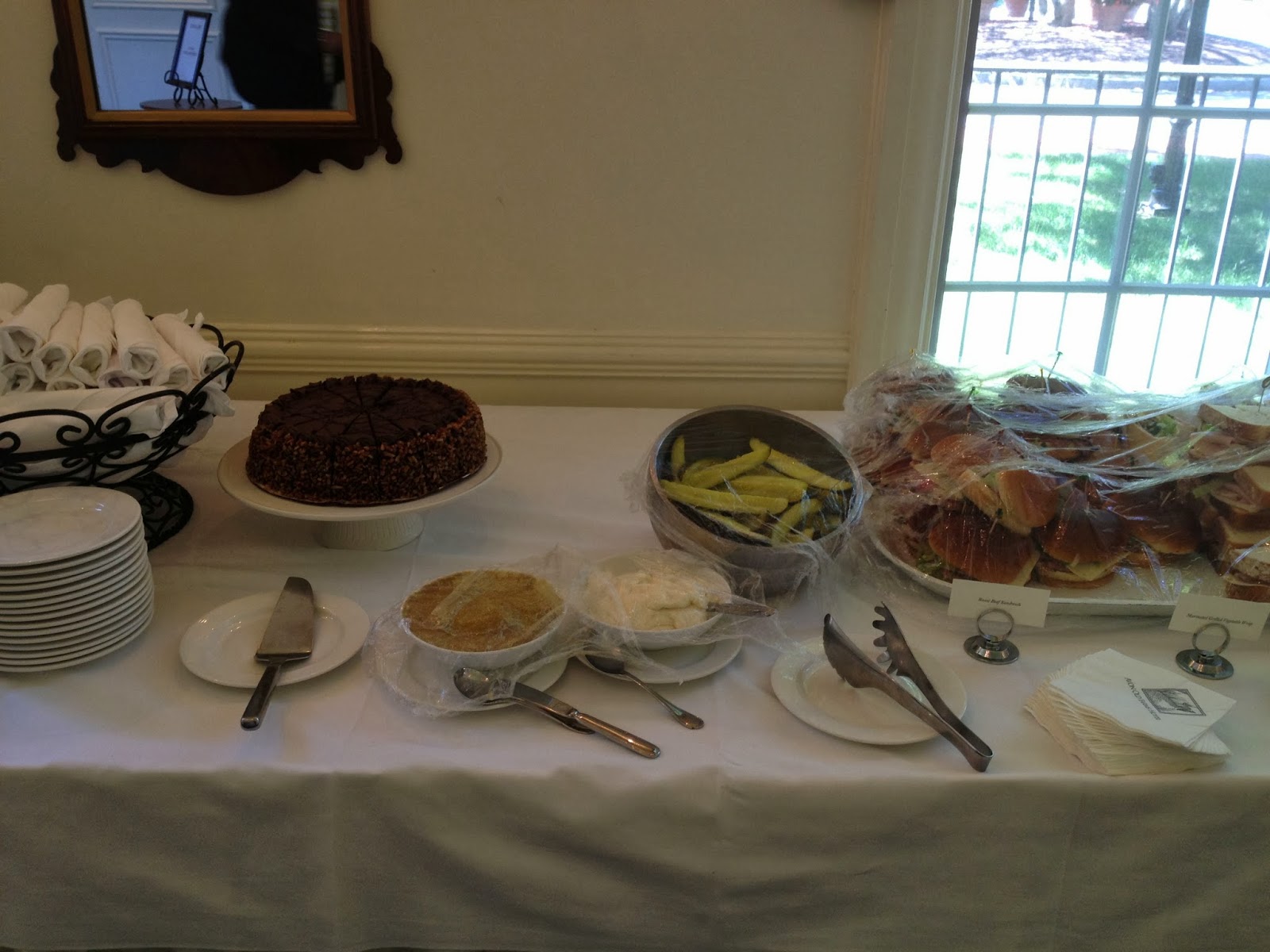
I was giving a talk at a conference in Connecticut today and walked up to the lunch buffet table when I heard one of the servers say to her supervisor, "Shouldn't we move the chocolate cake closer to the coffee? Then, the potato chips can be closer to the sandwiches, too."

Of course, she was right.  Look above.  The flow of customers gathering their main course is from right to left, using a large plate (not seen here) for their sandwiches, using the condiments, and adding a bag of chips to their plate.  The flow of customers getting desert would be from the far end of the table, moving left to right, getting their coffee or tea and picking up some cake using the small plates. As the table is organized, when the two flows get busy, they would interfere with each other.


Her supervisor said, "No, the cake has to be near the B&Bs [the bread and butter plates], so we can't move it."


Well, as you can see, it would be possible to switch the chips and the cake and reconfigure things slightly to still allow the B&Bs to be near the cake.

Sure enough, as lunch proceeded, traffic jams ensued between the people who were picking up their main courses and the ones who had already progressed to coffee and dessert.

I offer this not as a treatise in the proper placement of luncheon foods on a buffet line.  I offer it more as an example of a manager who quickly dismissed a suggestion from a staff member without engaging in a reasoned discussion of the alternatives.  We see this all the time in hospitals and other organizations, where a manager becomes blindly wedded to "the way we've always done it," and in so doing discourages front-line staff from offering suggestions for process improvement.

Friday, July 5, 2013

Ipswich leaders offer next steps on Lean

As we ended our Lean training workshops at Ipswich Hospital NHS Trust, I asked the participants to send me an email indicating what concrete steps or actions they would take in the next week to practice or implement some of the principles we had discussed.  Understand that I was not asking for a full implementation of the Lean philosophy in the hospital:  That requires a huge commitment at all levels of the organization and is something not lightly entered into.  Rather, I suggested that the basic principles of Lean can be practiced by managers and leaders at any time.  Quoting Don Berwick's line that "soon is not a time," I suggested that if you don't actually begin to practice those principles, they are easily left aside during day-to-day activities.  Here are some responses, with names omitted:

-- I think we do not do enough of this, that is the reflecting on the work we do and how we do it. There have been a few gems over these events, but one for me to highlight was the response that I did not get time to write after the second day of the course, when I was going to tell you how much I hated my office. It’s actually a nice room, light, airy, and well located, but I’m in it too much, and that’s why I don’t like it. The trip we had to stores was an important reminder for me to get out and about more – and I have now scheduled time in my weekly diary to do just this. In my own unit we have initiated a new ideas scheme, and I think this is a good practice, but your element of calling out issues, build on that even more, and I am now thinking about how we can recognise and encourage such behaviour. It’s funny that last night I realised that one of our excellent middle grades in the Oral department has called out just recently, pointing out an important issue with our outcome forms that we are now resolving. I intend to write about this in my next newsletter.

-- You might have already worked out the NHS problems such as long waiting period for clinic appointment, long waiting list for routine surgical operations, failure to meet targets,  ineffective utilization of theatre and some of the staffing issues in the department. I observed the measures the management teams are taking and miserably failing to sort out the problem or fixing it temporarily and finding them in the same situation again. I do not have any management training, but I try to put myself in a mangers position and think. Often, I think if they try a certain approach it could work. As a clinician, being in similar situation at other hospitals and seen different management strategies which work, I wish I could shout out my ideas and open a dialogue, eventually solve the crisis. But often people in management or power don't listen. I feel embarrassed and often apprehensive as how others take your opinion. Also, I do not want to offend my colleagues and consultants with ideas which will direct implication on them.  I sincerely hope this Lean workshop will help Ipswich Hospital to work out the areas which needs careful management intervention.

-- I will use every opportunity to visit the shop floor and in doing so change my approach to one of observation and learning. I will start referring to little changes that I have made each week when I meet with my senior team, and I will begin to ask them the same so that we can all learn from our changes and how these have been achieved.

-- In the next few weeks I want to implement a number of small projects implementing the Lean principles. These include looking at the way my colleague and I process colorectal referrals, which currently come to us in batches and take ages to work through, with the resultant work being delivered to the secretary all in one go. I am sure we can turn this into a continuous work flow.

This morning, I saw in the store room, theatre gowns, which I was told had stopped being ordered. They prevent my forearms being covered in blood after long abdominal and pelvic surgery. I will speak to the relevant people to ensure they are delivered to theatres on a regular basis. 

-- I have long thought that Lean is a system that we must embrace. I have read often of the benefits of its application in healthcare. However from your tutelage I now understand that it is a methodology first and foremost to improve the quality of care we give our patients. Any financial benefits are as a result of this ‘the virtuous relationship between quality and finance’ as you put it.  I think this fact is lost often in translation (the pun is intended!) and certainly has been an impediment to its dissemination in healthcare in the Ipswich.

It is my hope that as a result of your visit we now have a nidus of colleagues who have seen the huge potential of working in this way. I will try to bring us together, initially informally, once a fortnight to share our experiences and our successes. I am going to suggest that we each try to cascade Lean to one other individual every month and so on and so forth (a bit like Amway!). In time incrementally we will develop a philosophy across our shop floor of continuous improvements.  From our group we will identify someone to receive more comprehensive training to become our Lean coordinator or sensei.

-- I believe that the changes we make have to be sustainable. Small changes will make a difference. As an organisation facing many challenges, we must ensure we do not waste energy by repeating processes that do not work.

My mission will be to engender a 'can do ' attitude.I will challenge any negativity from staff, and  I will challenge myself to ensure I have the systems in place to allow all my staff the opportunity to contribute ideas and comments. I will work with my team leaders to action these.
I will challenge myself to visit areas in the Hospital I am unfamiliar with, in relation to the patient pathways and processes that affect patients who are cared for in my areas. This will help me understand the real experience the patient has and allow me to examine ways to improve the systems.
I will also invest some time to reorganise my office to improve my access to information etc!

-- Pledge to spend 1 hour a week with a colleague observing work with an aim to make improvements to their working life. And do this with respect for a co-worker who knows more about their job than I (as a manager) will ever know. Then ask that person to do the same for 1 of their colleagues to rapidly spread lean principles across the organisation.

-- After an energised afternoon looking at the 5S, I and my other 'Lean' colleagues returned to our offices. At least four of these colleagues took this opportunity to check their inbox. As responses hit my inbox during the time I sat also responding to emails. I asked myself 'Is email the best way to communicate this message?'

There must be alternative ways of conveying a message. I plan to involve staff by asking them to discuss the benefits and drawbacks of looking at other channels of communication
Could we consider a no email day? Why do we send an email when a face to face meeting or a phone call maybe more effective & even quicker than waiting for an email response.
Perhaps a coffee or lunch break with a group could be utilised to share information and we can encourage staff to think of alternative ways of communicating information.
I will review the types of information that I regularly send and receive. Many of them are to request information required on weekly or monthly. Instead of chasing on a weekly or monthly basis perhaps develop a timetable of the information required. 
My initial thoughts are that perhaps phone calls and face to face meetings could be more time consuming however as an organisation we need to make a real effort to reduce email overload and I believe this has the potential to ensure better teamwork, a quicker problem solving approach and a happier workforce.
-- Next week I plan to improve our ultrasound scanning service to inpatients.
At present, at the start of the day, all the pending inpatient ultrasound scan request forms are reviewed by the radiologist scheduled to perform the scans. This means there is a flurry of activity (batching of work) in the early morning with the radiologist sorting through a large pile of paper forms, the imaging assistant ringing the wards with instructions and writing out collection slips for the porters, the ward clerks receiving those instructions and passing on the information to the relevant nursing staff who in turn speak to their patients about what is about to happen. It is all a mini whirlwind as this needs to occur before the radiologist starts scanning the first patients on the list (who are outpatients arranged in advance - to prevent downtime whilst waiting for the first inpatient to arrive). 

The rush means it is stressful for all in the chain. For the imaging assistant it means time on the phone and liaising with the porters when she should be helping with the first (out)patients. On the ward other tasks are interrupted to prepare their patients to come down for their scan. Because of the short notice often the doctors on the ward rounds do not know that the scans have been scheduled and ring up to enquire if and when the scans will be performed thereby disturbing the radiologist who has to stop scanning the patient of the moment. Additionally, there is frequently inadequate time to get the necessary preparation right, e.g. the patient for a pelvic scan has an under filled bladder and the scan is inadequate or worse still needs to be repeated. Most importantly, the patient and their relatives, who have usually been told by their attending ward doctors that they need a scan, are anxiously waiting not knowing what is happening for longer. 

How can we make this better? 

One possible way would be to review all outstanding request forms at the end of each afternoon and schedule the scans for the next day. That way everyone knows well in advance and can be planned to fit in around other activities. Waste could be reduced. 

Can I persuade my colleagues to change? Will they come up with a better solution? Watch this space.

-- Have largely been doing this process for the last 7 years thus the result of a large well functioning AMU which is Nationally acclaimed for its results.  My steps now will be to insist other departments work with us in the same way to allow a smooth patient journey...first e mail has been met with horror so far!!

-- I am currently tidying my office!

Last week we had a crisis meeting about an inability to find slots for patients to have lung function tests. I now realise how we can make the situation better but using existing capacity in a smarter way. In the next week I intent to meet with our lung function unit manager to find a way of better matching his work load to the chest clinics. His team appear to run the same timetable every day even though the chest clinics are not evenly distributed.  Also, if I go on holiday, I don’t warn him that this is the case and so he can’t plan a different task for his technicians.  Given enough warning they could book more patients for routine tests on these days that don’t have to be coordinated with my clinic.

-- I have today agreed to mentor a colleague who works at a supervisory level in the Trust, meeting her once a fortnight to discuss the issues she faces, and help her to work through them.  I plan to share practical Lean principles during these sessions with her.

Whatever I am doing I will always watch, listen to and spend time with my teams to truly identify the root of problems/obstacles; working with the team to resolve them together – this is the crux of every manager’s job!

Tuesday, June 25, 2013

Please be persistently dissatisfied

A tweet by @dripchamber caught my eye:

If I ever say, "Overall we're happy with the way the hospital is headed, infection-wise," please shoot me.

And the s/he links to this article in the Baltimore Brew.  An excerpt:

After one of the deadliest weekends in Baltimore in several years – 8 people dead, 20 shot in all during the period from Friday afternoon to Monday morning – comments by the city police spokesman are prompting blistering criticism in some quarters. 

“This is a little bit of a spike in terms of the weekend, but all in all, we’re pretty satisfied with the way the city is headed, violence-wise,” Guglielmi said, in Carrie Wells’ story in today’s Baltimore Sun. 

I loved@dripchamber's comment, not only for the clever directive that alludes to the violence covered in the article, but more importantly for what it stands for about quality improvement in hospitals.  Indeed, about quality improvement anywhere.

I have yet to meet any serious adherent to the concept of quality improvement who is ever satisfied with regard to progress made.  As my friend and colleague Roger Berkowitz, CEO of Legal Sea Foods, is wont to say about quality in his restaurants: "This is always a work in progress."  (Disclosure: I am on the LSF board.  Mainly because of Roger's commitment to quality.  But also because of the clam chowder!)

In the hospital world, whether people are engaged in Lean process improvement or another approach to the issue, the primary characteristic of those furthest along is modesty.  "We've learned a lot," they might say, "but mainly we've learned how far we have to go."

This implies a need for curiosity and experminentation and a leadership cadre that encourages blame-free learning at all levels in the organization.

As Virginia Mason's Sarah Patterson has said: "Just tell them to do it. Don't be afraid. It won't be perfect. Try it. Fail. Try it. Change. Keep going."

Tuesday, May 7, 2013

Creating an insatiable appetite for improvement

John S. Toussaint and Leonard L. Berry masterfully set forth the essence of Lean in an article entitled, "The Promise of Lean in Health Care."

Lean is not a program; it is not a set of quality improvement tools; it is not a quick fix; it is not a responsibility that can be delegated. Rather, Lean is a cultural transformation that changes how an organization works; no one stays on the sidelines in the quest to discover how to improve the daily work. It requires new habits, new skills, and often a new attitude throughout the organization from senior management to front-line service providers. Lean is a journey, not a destination. Unlike specific programs, Lean has no finish line. Creating a culture of Lean is to create an insatiable appetite for improvement; there is no turning back. As Lean consultant Joan Wellman states,“With Lean, you will keep changing your definition of what ‘good’ is."

Mayo Foundation for Medical Education and Research: Mayo Clin Proc. 2013;88(1):74-8.

Monday, April 8, 2013

John Toussaint provides a roadmap to Lean success

This should be an excellent (and free) webinar, given by John Toussaint, one of the true experts in hospital process improvement.  Here's a description from Joshua Rapoza at the Lean Enterprise Institute.

I'd like to invite you to join us April 16, 2013, at 2:00 pm (Eastern) for the 60-minute, free webinar "A Roadmap to Lean Healthcare Success" with John Toussaint, MD, CEO of the ThedaCare Center for Healthcare Value, author of On the Mend, and a national leader in improving healthcare through lean principles.

As CEO of ThedaCare, Dr. Toussaint introduced the successful ThedaCare Improvement System, a lean healthcare system.

In this webinar and Q&A, he'll describe a roadmap to lean healthcare success, based on his visits to 120 healthcare organizations as well as many visits to leading lean manufacturing companies.

Learn what Dr. Toussaint will cover and how to register.

Wednesday, February 27, 2013

When the doors of the mind open

I’ve often wondered why the psychiatric wards are the most drab and depressing parts of hospitals.  After all, you’d think that the architects and interior designers would be instructed by the facilities administrators to brighten things up for those patients suffering from mental illness and for the clinical staff who take care of them.  But no.  You know, even from the outside of the ward, that this is an unpleasant environment.  The door to a locked ward, with at best a small window looking in and out, is placed at the end of a dark corridor, surrounded by a wall colored in institutional gray or green, and often with no sign indicating what is inside.  Hope is quashed.

That despair is precisely what Teresa Pasquini, the mother of a young man with mental disease, noticed at Contra Costa Medical Center in Martinez, CA.  She notes: “The doors of the psychiatric units were seen as the hospital’s property and a way to control access.  Visitors were also controlled, and the mysterious world of the psychiatric units were misunderstood and often feared.  The entry into this emergency service was bare and unwelcoming.”

But change was possible, through a broadly inclusive Lean behavioral health rapid improvement event.  She explains:  “The Lean process takes you away from the meeting room and puts you on the front line of care observing each process.  This allows you to recognize what is waste and what has value.  Lean lets you see across the silos of the system and recognize the delays, the redundancies and harm.”

Indeed, while much of the focus of Lean is often on waste attributed to classical manufacturing concepts like excess transport, inventory, and waiting, those of us engaged in Lean often point out that one of the key wastes is “the waste of human potential.”  Unfortunately, if there is ever a part of a hospital that is likely to feature the waste of human potential--both of staff and patients--it is in the mental health areas.

Look at this simple result.  Teresa explains:  “With the help of a community partnership and three mental health consumers, who designed and painted the entrance to the psychiatric emergency area, this door now symbolizes the commitment to patient and family partnership and to co-producing a more welcoming and accessible experience for all who come here for care.”

Tuesday, February 26, 2013

Rabble rousers say, "We are the expert system navigators"

Teresa Pasquini (above, left) is a self-styled rabble rouser, "the queen of the letter writers," who used to spend hours trying to get her local hospital to do a better job caring for patients.  Who better then for CEO Anna Roth (above, right) to recruit as one of the first Family Member Partners for the Contra Costa County Regional Medical Center & Health Centers.

Patient-family advisory councils have been described as "the next blockbuster drug," the single most important advance in the delivery of medical care that is likely to show up in hospitals.  I had the pleasure today as Teresa and Anna participated in a webinar offered by the National Association of Public Hospitals on the topic of patient an family engagement.  Appropriately, most of the time in the webinar was taken by Teresa describing her motivation and involvement in the PFE process.  Her first statement got my attention, and the rest of her talk kept it.  Here are some excerpts:

I need to start my comments by sharing what drives my passion and commitment to this work.  I am the proud mom of a 30-year-old son with schizoaffective disorder who has spent the majority of the past 14 years in psychiatric facilities behind locked doors.

Doors, hope and harm have been a running theme in our life since our son was diagnosed.

My son has been hospitalized over 30 times in several locked facilities.  The past 14 years have been a blur of suicide attempts, over 40 involuntary holds, revolving hospitalizations, and a permanent conservatorship.  With a diagnosis at age 16, we began to navigate a maze of services in one of the most integrated health care systems.  It was a nightmare.

I was an angry mom when I was invited to my first Lean event at CCRMC.

Prior to this event, there was concern about me whispered around the tables and behind closed doors.  Cautious warnings were shared about my outspoken, even radical, direct action approach.  Fortunately, the Administration of CCRMC took a risk and opened their doors and minds and even encouraged me to push them forward.  The first event was the beginning of a special human connection that ignited our shared vision of hope.

Our partnership started off without clear direction.  There were underlying control issues.  We moved cautiously building trust and respect.  By staying at the table we began to overcome our fears and find our way to the "field beyond right and wrong."

We were teaching and learning together and laying down the tools that had been failing.  We were challenging the system and embracing the tension that comes from change.  And there was tension.

The tension was often whispered offline or subtly felt in meetings.  The staff was not trained to be open with "outsiders" in the room.  The patients and families were not familiar with "medicine speak." But through determination, courage, and leadership, the comfort level increased and transformation began.

Contra Costa County Health Services has shown bold courage by offering our community a trusting, authentic, shared learning experience and partnership that goes beyond the traditional advisory role.  We are not token advisors but rather equal and respected partners.  We have learned to speak the truth, hear the truth, and go and see the truth.  With constancy of purpose and focused direct action, we are co-creating a system where the consumers, families, community organizations, clinicians and staff work in a true partnership.  No politics, no discrimination, no special interest, no egos, just pure ethical health care based on the needs of the patient.  I have seen it happen.  It is possible.

Nothing is scarier that the health system when your child is sick.  Please, don't be afraid of an an angry mom or patient.  Invite family members like mine to tell you our experiences and let us help you create solutions.  Nobody comes to work to harm others.  We are the expert system navigators and we will help you design a better system for all.