But take a look anyway, if you have an interest in process improvement in hospitals. This is a collection of my best posts on this topic.

Tuesday, September 24, 2013

A solution to clutter

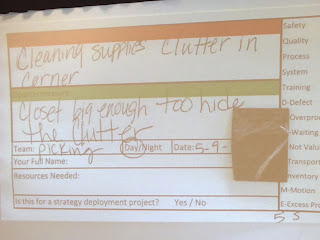
#GBMP1 Sometimes unexpected proposed countermeasures to problems called out during Lean process improvement efforts come up.  Look at the one proposed here on a suggestion form!  While Lean envisions countermeasures as temporary or iterative or interim solutions to problems, I don't think even the most creative of Lean experts would have come up with this one--even for the short term.


Thanks to Gary Peterson at O. C. Tanner for this humorous example.

Notes from a Lean conference

#GBMP1 I'm currently attending the 9th Annual Northeast Shingo Prize Conference presented by GBMP, a non-profit that is engaged in Lean educational programs.  Entitled, "True North: Set the Course, Make Waves," the conference began with a short introduction by GBMP's president, Bruce Hamilton.  Regular readers will recognize Bruce as the star of Toast Kaizen, a wonderful video illustrating Lean principles in the "production" of toast in a kitchen.  He began with the concept of "True North," which he defined as "the way things should be," but importantly the way things should be for both customers and those providing service to customer.

The keynote speaker was Gary Peterson, EVP for supply chain and production at The O.C. Tanner Company.  "We've made a ton of mistakes" with our Lean journey, he began:

Most of the mistakes we've made centered on our people.  We implemented tools and imposed them on our people.  They worked, but people hated it. We hired "a cop" to enforce use of the tools.  "That should have made it obvious that we were doing something wrong!"

The fundamental principle has to be respect for people, he noted.  He suggested that there are four things that are critical for getting people involved:

(1) Setting a clear vision:  Establishing an understanding of True North (an aspirational vision of what might be achieved--but paradoxically might be unlikely ever to be achieved), provide free flowing information, engage in true transparency.  "By the way," he noted, "Things somehow move from aspirational to the way things are!"

(2) Providing a powerful reason for engagement.  Don't use, "If we don't do this we may go out of business."  Focus on the purpose of the organization, the intrinsic reasons that make daily work meaningful and create a sense of pride.  (By the way, check out his company's blog to get a sense of this.)

(3) Engaging in a thoughtful and good improvement methodology.  Develop people for contribution, particularly helping people evolve into leadership roles that are supportive of the philosophy.  "We want eveyone to become leaders." Minimize rules that control: Avoid systems that get in the way. "Don't act like you are cutting them loose and then have them drag a chain behind themselves." Hire well: Ensure that they believe in the elements of a living culture--safety, continuous improvement, trust, respect for others, we are all in this together, Arbinger principles (avoiding self-deception.)

(4) Inspiring a desire to continue to do it and stay engaged.  Make it fun to learn and safe to venture into unknown territory.  Above all, "Show me you value my efforts."  Help people believe: "There is no secret ingredient."

Thursday, September 19, 2013

How to keep Lean while eating

One of the dangers of becoming a Lean aficionado is that you see opportunities for process improvement everywhere.  Also, you feel an affinity for people who are able to go to gemba (the place where work is done) and, either by training or by intuition, look at work flows and find ways to improve them.  You have sympathy for them when their supervisors are unable to recognize their helpful suggestions or respond approrpriately.


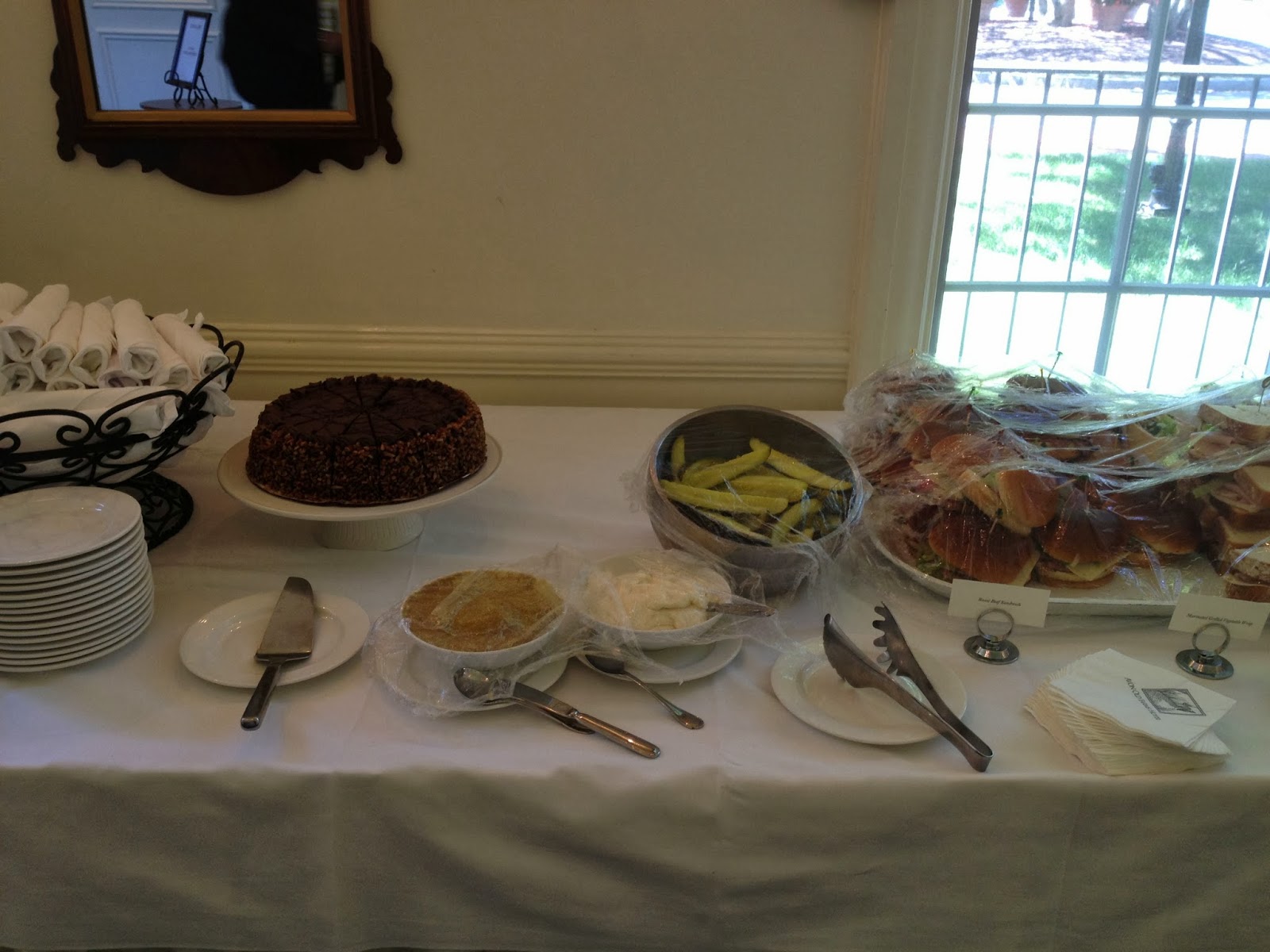
I was giving a talk at a conference in Connecticut today and walked up to the lunch buffet table when I heard one of the servers say to her supervisor, "Shouldn't we move the chocolate cake closer to the coffee? Then, the potato chips can be closer to the sandwiches, too."

Of course, she was right.  Look above.  The flow of customers gathering their main course is from right to left, using a large plate (not seen here) for their sandwiches, using the condiments, and adding a bag of chips to their plate.  The flow of customers getting desert would be from the far end of the table, moving left to right, getting their coffee or tea and picking up some cake using the small plates. As the table is organized, when the two flows get busy, they would interfere with each other.


Her supervisor said, "No, the cake has to be near the B&Bs [the bread and butter plates], so we can't move it."


Well, as you can see, it would be possible to switch the chips and the cake and reconfigure things slightly to still allow the B&Bs to be near the cake.

Sure enough, as lunch proceeded, traffic jams ensued between the people who were picking up their main courses and the ones who had already progressed to coffee and dessert.

I offer this not as a treatise in the proper placement of luncheon foods on a buffet line.  I offer it more as an example of a manager who quickly dismissed a suggestion from a staff member without engaging in a reasoned discussion of the alternatives.  We see this all the time in hospitals and other organizations, where a manager becomes blindly wedded to "the way we've always done it," and in so doing discourages front-line staff from offering suggestions for process improvement.
Friday, July 5, 2013

Ipswich leaders offer next steps on Lean

As we ended our Lean training workshops at Ipswich Hospital NHS Trust, I asked the participants to send me an email indicating what concrete steps or actions they would take in the next week to practice or implement some of the principles we had discussed.  Understand that I was not asking for a full implementation of the Lean philosophy in the hospital:  That requires a huge commitment at all levels of the organization and is something not lightly entered into.  Rather, I suggested that the basic principles of Lean can be practiced by managers and leaders at any time.  Quoting Don Berwick's line that "soon is not a time," I suggested that if you don't actually begin to practice those principles, they are easily left aside during day-to-day activities.  Here are some responses, with names omitted:

-- I think we do not do enough of this, that is the reflecting on the work we do and how we do it. There have been a few gems over these events, but one for me to highlight was the response that I did not get time to write after the second day of the course, when I was going to tell you how much I hated my office. It’s actually a nice room, light, airy, and well located, but I’m in it too much, and that’s why I don’t like it. The trip we had to stores was an important reminder for me to get out and about more – and I have now scheduled time in my weekly diary to do just this. In my own unit we have initiated a new ideas scheme, and I think this is a good practice, but your element of calling out issues, build on that even more, and I am now thinking about how we can recognise and encourage such behaviour. It’s funny that last night I realised that one of our excellent middle grades in the Oral department has called out just recently, pointing out an important issue with our outcome forms that we are now resolving. I intend to write about this in my next newsletter.

-- You might have already worked out the NHS problems such as long waiting period for clinic appointment, long waiting list for routine surgical operations, failure to meet targets,  ineffective utilization of theatre and some of the staffing issues in the department. I observed the measures the management teams are taking and miserably failing to sort out the problem or fixing it temporarily and finding them in the same situation again. I do not have any management training, but I try to put myself in a mangers position and think. Often, I think if they try a certain approach it could work. As a clinician, being in similar situation at other hospitals and seen different management strategies which work, I wish I could shout out my ideas and open a dialogue, eventually solve the crisis. But often people in management or power don't listen. I feel embarrassed and often apprehensive as how others take your opinion. Also, I do not want to offend my colleagues and consultants with ideas which will direct implication on them.  I sincerely hope this Lean workshop will help Ipswich Hospital to work out the areas which needs careful management intervention.

-- I will use every opportunity to visit the shop floor and in doing so change my approach to one of observation and learning. I will start referring to little changes that I have made each week when I meet with my senior team, and I will begin to ask them the same so that we can all learn from our changes and how these have been achieved.

-- In the next few weeks I want to implement a number of small projects implementing the Lean principles. These include looking at the way my colleague and I process colorectal referrals, which currently come to us in batches and take ages to work through, with the resultant work being delivered to the secretary all in one go. I am sure we can turn this into a continuous work flow.

This morning, I saw in the store room, theatre gowns, which I was told had stopped being ordered. They prevent my forearms being covered in blood after long abdominal and pelvic surgery. I will speak to the relevant people to ensure they are delivered to theatres on a regular basis. 

-- I have long thought that Lean is a system that we must embrace. I have read often of the benefits of its application in healthcare. However from your tutelage I now understand that it is a methodology first and foremost to improve the quality of care we give our patients. Any financial benefits are as a result of this ‘the virtuous relationship between quality and finance’ as you put it.  I think this fact is lost often in translation (the pun is intended!) and certainly has been an impediment to its dissemination in healthcare in the Ipswich.

It is my hope that as a result of your visit we now have a nidus of colleagues who have seen the huge potential of working in this way. I will try to bring us together, initially informally, once a fortnight to share our experiences and our successes. I am going to suggest that we each try to cascade Lean to one other individual every month and so on and so forth (a bit like Amway!). In time incrementally we will develop a philosophy across our shop floor of continuous improvements.  From our group we will identify someone to receive more comprehensive training to become our Lean coordinator or sensei.

-- I believe that the changes we make have to be sustainable. Small changes will make a difference. As an organisation facing many challenges, we must ensure we do not waste energy by repeating processes that do not work.

My mission will be to engender a 'can do ' attitude.I will challenge any negativity from staff, and  I will challenge myself to ensure I have the systems in place to allow all my staff the opportunity to contribute ideas and comments. I will work with my team leaders to action these.
I will challenge myself to visit areas in the Hospital I am unfamiliar with, in relation to the patient pathways and processes that affect patients who are cared for in my areas. This will help me understand the real experience the patient has and allow me to examine ways to improve the systems.
I will also invest some time to reorganise my office to improve my access to information etc!

-- Pledge to spend 1 hour a week with a colleague observing work with an aim to make improvements to their working life. And do this with respect for a co-worker who knows more about their job than I (as a manager) will ever know. Then ask that person to do the same for 1 of their colleagues to rapidly spread lean principles across the organisation.

-- After an energised afternoon looking at the 5S, I and my other 'Lean' colleagues returned to our offices. At least four of these colleagues took this opportunity to check their inbox. As responses hit my inbox during the time I sat also responding to emails. I asked myself 'Is email the best way to communicate this message?'

There must be alternative ways of conveying a message. I plan to involve staff by asking them to discuss the benefits and drawbacks of looking at other channels of communication
Could we consider a no email day? Why do we send an email when a face to face meeting or a phone call maybe more effective & even quicker than waiting for an email response.
Perhaps a coffee or lunch break with a group could be utilised to share information and we can encourage staff to think of alternative ways of communicating information.
I will review the types of information that I regularly send and receive. Many of them are to request information required on weekly or monthly. Instead of chasing on a weekly or monthly basis perhaps develop a timetable of the information required. 
My initial thoughts are that perhaps phone calls and face to face meetings could be more time consuming however as an organisation we need to make a real effort to reduce email overload and I believe this has the potential to ensure better teamwork, a quicker problem solving approach and a happier workforce.
-- Next week I plan to improve our ultrasound scanning service to inpatients.
At present, at the start of the day, all the pending inpatient ultrasound scan request forms are reviewed by the radiologist scheduled to perform the scans. This means there is a flurry of activity (batching of work) in the early morning with the radiologist sorting through a large pile of paper forms, the imaging assistant ringing the wards with instructions and writing out collection slips for the porters, the ward clerks receiving those instructions and passing on the information to the relevant nursing staff who in turn speak to their patients about what is about to happen. It is all a mini whirlwind as this needs to occur before the radiologist starts scanning the first patients on the list (who are outpatients arranged in advance - to prevent downtime whilst waiting for the first inpatient to arrive). 

The rush means it is stressful for all in the chain. For the imaging assistant it means time on the phone and liaising with the porters when she should be helping with the first (out)patients. On the ward other tasks are interrupted to prepare their patients to come down for their scan. Because of the short notice often the doctors on the ward rounds do not know that the scans have been scheduled and ring up to enquire if and when the scans will be performed thereby disturbing the radiologist who has to stop scanning the patient of the moment. Additionally, there is frequently inadequate time to get the necessary preparation right, e.g. the patient for a pelvic scan has an under filled bladder and the scan is inadequate or worse still needs to be repeated. Most importantly, the patient and their relatives, who have usually been told by their attending ward doctors that they need a scan, are anxiously waiting not knowing what is happening for longer. 

How can we make this better? 

One possible way would be to review all outstanding request forms at the end of each afternoon and schedule the scans for the next day. That way everyone knows well in advance and can be planned to fit in around other activities. Waste could be reduced. 

Can I persuade my colleagues to change? Will they come up with a better solution? Watch this space.

-- Have largely been doing this process for the last 7 years thus the result of a large well functioning AMU which is Nationally acclaimed for its results.  My steps now will be to insist other departments work with us in the same way to allow a smooth patient journey...first e mail has been met with horror so far!!

-- I am currently tidying my office!

Last week we had a crisis meeting about an inability to find slots for patients to have lung function tests. I now realise how we can make the situation better but using existing capacity in a smarter way. In the next week I intent to meet with our lung function unit manager to find a way of better matching his work load to the chest clinics. His team appear to run the same timetable every day even though the chest clinics are not evenly distributed.  Also, if I go on holiday, I don’t warn him that this is the case and so he can’t plan a different task for his technicians.  Given enough warning they could book more patients for routine tests on these days that don’t have to be coordinated with my clinic.

-- I have today agreed to mentor a colleague who works at a supervisory level in the Trust, meeting her once a fortnight to discuss the issues she faces, and help her to work through them.  I plan to share practical Lean principles during these sessions with her.

Whatever I am doing I will always watch, listen to and spend time with my teams to truly identify the root of problems/obstacles; working with the team to resolve them together – this is the crux of every manager’s job!

Tuesday, June 25, 2013

Please be persistently dissatisfied

A tweet by @dripchamber caught my eye:

If I ever say, "Overall we're happy with the way the hospital is headed, infection-wise," please shoot me.

And the s/he links to this article in the Baltimore Brew.  An excerpt:

After one of the deadliest weekends in Baltimore in several years – 8 people dead, 20 shot in all during the period from Friday afternoon to Monday morning – comments by the city police spokesman are prompting blistering criticism in some quarters. 

“This is a little bit of a spike in terms of the weekend, but all in all, we’re pretty satisfied with the way the city is headed, violence-wise,” Guglielmi said, in Carrie Wells’ story in today’s Baltimore Sun. 

I loved@dripchamber's comment, not only for the clever directive that alludes to the violence covered in the article, but more importantly for what it stands for about quality improvement in hospitals.  Indeed, about quality improvement anywhere.

I have yet to meet any serious adherent to the concept of quality improvement who is ever satisfied with regard to progress made.  As my friend and colleague Roger Berkowitz, CEO of Legal Sea Foods, is wont to say about quality in his restaurants: "This is always a work in progress."  (Disclosure: I am on the LSF board.  Mainly because of Roger's commitment to quality.  But also because of the clam chowder!)

In the hospital world, whether people are engaged in Lean process improvement or another approach to the issue, the primary characteristic of those furthest along is modesty.  "We've learned a lot," they might say, "but mainly we've learned how far we have to go."

This implies a need for curiosity and experminentation and a leadership cadre that encourages blame-free learning at all levels in the organization.

As Virginia Mason's Sarah Patterson has said: "Just tell them to do it. Don't be afraid. It won't be perfect. Try it. Fail. Try it. Change. Keep going."

Tuesday, May 7, 2013

Creating an insatiable appetite for improvement

John S. Toussaint and Leonard L. Berry masterfully set forth the essence of Lean in an article entitled, "The Promise of Lean in Health Care."

Lean is not a program; it is not a set of quality improvement tools; it is not a quick fix; it is not a responsibility that can be delegated. Rather, Lean is a cultural transformation that changes how an organization works; no one stays on the sidelines in the quest to discover how to improve the daily work. It requires new habits, new skills, and often a new attitude throughout the organization from senior management to front-line service providers. Lean is a journey, not a destination. Unlike specific programs, Lean has no finish line. Creating a culture of Lean is to create an insatiable appetite for improvement; there is no turning back. As Lean consultant Joan Wellman states,“With Lean, you will keep changing your definition of what ‘good’ is."

Mayo Foundation for Medical Education and Research: Mayo Clin Proc. 2013;88(1):74-8.

Monday, April 8, 2013

John Toussaint provides a roadmap to Lean success

This should be an excellent (and free) webinar, given by John Toussaint, one of the true experts in hospital process improvement.  Here's a description from Joshua Rapoza at the Lean Enterprise Institute.

I'd like to invite you to join us April 16, 2013, at 2:00 pm (Eastern) for the 60-minute, free webinar "A Roadmap to Lean Healthcare Success" with John Toussaint, MD, CEO of the ThedaCare Center for Healthcare Value, author of On the Mend, and a national leader in improving healthcare through lean principles.

As CEO of ThedaCare, Dr. Toussaint introduced the successful ThedaCare Improvement System, a lean healthcare system.

In this webinar and Q&A, he'll describe a roadmap to lean healthcare success, based on his visits to 120 healthcare organizations as well as many visits to leading lean manufacturing companies.

Learn what Dr. Toussaint will cover and how to register.