But take a look anyway, if you have an interest in process improvement in hospitals. This is a collection of my best posts on this topic.

Saturday, June 2, 2012

There are no big problems, there are just a lot of little problems.

If the first chapter is any indication, Healthcare Kaizen, a forthcoming book by Mark Graban and Joseph Swartz, will quickly rise to the "must have" category for people interested in adopting the Lean process improvement philosophy for their organizations.  Mark has worked as a consultant and coach to healthcare organizations throughout North America and Europe. Joseph is the Director of Business Transformation for Franciscan St. Francis Health of Indianapolis, IN.

This is more than a how-to book.  It promises to be replete with examples of success and failure.  I found these simple stories to be inspirational, while also exemplifying the underlying premise of Lean:  Empowerment of front-line staff.

The authors note:  "In this book, we will use the term Kaizen in the context that is often least practiced and least appreciated in healthcare (as well as other industries)—continuous improvements that happen without the formal structure of a large team or a major project.."

"Kaizens tend to be small, local changes at first. In many organizations, the focus of improvement is on innovation or larger scale improvements, or home runs, to use a baseball analogy. . . . A Kaizen organization supplements necessary and large, strategic innovations with lots of small improvement ideas—the equivalent of singles and doubles in baseball. The expectation is that a large number of small changes leads to an impressive impact to an organization’s core measures. Small changes, which can be completed more quickly than major projects, can build enthusiasm and problem-solving skills that people can then apply to larger problems."

Here's one example:

Changing Back Can Be Better for Babies

In early 2008, the Franciscan maintenance department replaced the manual paper towel dispensers in the NICU with hands-free automatic paper towel dispensers. One automated dispenser located near a group of babies made a loud grinding noise each time it dispensed a paper towel and nurses noticed babies flinching when this happened. Occasionally, the noise would wake one of the babies and the nurses knew how important rest was for recovery. Most of Paula Stanfill’s nurses chose a career in the NICU because of their passion and compassion for babies.

After some debate, her nurses suggested they go back to the manual dispensers . Paula wondered if she should let them because it seemed as though they were going backward. Then, her staff measured the decibel level of the automatic paper towel dispenser and found it was greater than 50 decibels. Paula was convinced. She approved having the automatic dispenser removed and replaced with the old manual paper towel holder. It was not as fancy, but it was better for the babies under their care. The babies were happier and healthier, which led to happier staff, which made Paula happy. Their Kaizen Report is shown in Figure 1.5. Paula learned that she needed to listen.


For more information, visit the book's website.

Wednesday, April 18, 2012

Sarah Patterson informs about Lean

#qualitysummit  Another featured speaker at the Saskatchewan Health Care Quality Summit was Sarah Patterson, executive vice president and chief operating officer of Virginia Mason Medical Center, the leading adopter and proponent of Lean (or Toyota Production System) process improvement in hospitals.  Her presentation was a masterpiece of description and discussion of the Lean philosophy.  If it is posted on the web, it will be well worth your time.  In the meantime, as I did for the Jim Easton talk, I am going to post my live Twitter feeds to give you a sense of her major points.

Patterson: Using Lean provides a common language for process improvement. Small size of province offers oppty to experiment.

We understand the important role of leadership, throughout the organization.

Other orgs often talk about inability to sustain progress. Frustration of lack of stability.

Would like Va Mason org to operate like an aircraft carrier. How to run a complex business safety.

Aircraft carrier= an airport on top of a nuclear power plant comprising a bunch of 19 year olds!

Aircraft carrier needs complete alignment with the mission. If not done well, puts others at risk.


Aircraft carrier requires an incredible commitment to adoption of standard work. Relentless focus on training.

Aircraft carrier requires enforcement of accountability.

Create jobs that are doable. Train people to do them. Hold people accountable to them.


Virginia Mason story begins in 2000, looking for way to improve and assurance of accomplishing that.

Adopted TPS=customer first, highest quality, obsession w/ safety, staff engagement, successful economic enterprise

Declaration of zero defects was unheard of in health care. Essential aspect of TPS (Lean).


"Elegant" staff engagement system is inherent in Lean.

Lean 4Ps=philosophy; process; people and partners; problem solving. Not a program! A long-term philosophy.

TPS focus on process, not on the outcomes. Build key features into processes that are waste free, continuous flow.

Grow leaders. Respect, develop, and challenge your people, but also vendors (who are partners.)

Problem solving, knowing what is going on on the front lines, when problems are fresh.

AT VM, still have problem implementing and sustaining standard work, e.g., in primary care.

92% of Rapid Improv. Event results sustained after 2 months. Not good enough. Would drop further after 6 months.

Could this be because of current management system? Too much reliance based on superheroes? Great crisis mgrs?

Sterile processing superhero, knew everything, went on vacation! Surgeons left unserved!

VMason had to go back to TPS training. What did we miss?Hadn't given middle mgrs enough training about new roles.

Middle mgrs viewed TPS as an add-on, additional work with new tools. Need comprehensive mgmt system.Back to school!

Need regular management presence where the work happens. A transparent environment. Clear and complete goals.

Mgmt by policy + daily mgmt + cross-functional mgmt = world-class mgmt system.

Management by policy = long term vision, 5 year plans, annual goals.Reflection.Share environmental scan with all.

Mgmt by policy: One stage is "Catchball." Draft of policy shared deeply in the organization. Get feedback.

Catchball staff engagement, shared with 1000 people last year. Next year, 5000.

Deployment. Need process for negotiating what is effective work, resources required, and people's commitment.

More careful scoping of projects is an imp discussion to have in the organization. Signoff by key people.

Multiple executives responsible for projects. E.g., CFO responsible for safety improvements!

Regular mtg for check and review. Short updates. Who needs our help?

Cross-functional work is essential. Where creativity really happens. Blame for silos lies with the top leaders.


(Me) Review what she says to see a fundamentally different role for leaders.


Daily mgmt: Know at a glance status of work. Satisfying customer demand? Std work being followed? Engaging staff?

If our front line staff are telling us it is bad, do we know this? Are we acting to help fix it?

Leaders' 2 jobs. 1 -- Run your business, while ensuring stability. 2 -- Improve your business.

Start with understanding your demand; and knowing your supply; standard work developed and posted.

Track your business on a HOURLY basis, or you can't understand process flaws and improvement opp'ties.

Everybody on the floor needs visual cues as to status of work and meeting customer demand. In real time!!!

Every hospital needs in-the-room nurse-to-nurse bedside handoff. Every time.

Toyota cord-pulls, happens often. 30 second response by leader to be on worker's side.

In hospitals, too, need real-time ID of problems and responsiveness by leader. At the work station!

Elements of daily management = leader standard work + visual controls + daily accountability process + discipline.

Whoa! Leader standard work, too! What a concept. Can't be "too busy" for this!

With leader standard work made visible, staff now know, "Oh that's what leaders do!"

Visual controls focus on the process and make it easy to compare expected with actual performance.

At Virginia Mason, patients can see the visual controls in the waiting rooms -- e.g., MD-specific delays.

If MD gets behind by more than 10 minutes, resources are brought to bear to provide support and get back on sched.

Other visual cue examples.Note: Not sophisticated computer reports.Just white boards with stickies! In real time!

Gives list of foundational elements of hospital nursing care. Every unit, every day. Auditing process, too!

Choreographed and sequenced system of daily accountability. All units have daily huddle.

Daily accountablity. PeopleLink Board used for 30 minute stand-up meeting once a week.

Senior leader regular gemba rounds to view one aspect of standard work.

"I'd rather have no board rather than an out-of-date board. They have to be real."

Email from Amy, "I'm just a biller, but I look forward to every Thursday morning at 7:30."

Amy, "We have a common purpose and a common language."

Audience Q:  Recruitment. Didn't want people who had all the answers. Looked for curiosity. Learners. Communication skills.

Created leadership development curriculum to develop competencies, but look for innate characteristics.

Audience Q: How to take current work off the plate? A: Take things away (reports) that are needed. But don't wait.

Things that used to take leaders a lot of time don't take time, because of connection to staff, issues tracking.

"Just tell them to do it. Don't be afraid. It won't be perfect. Try it. Fail. Try it. Change. Keep going."


Jim Easton inspires

#qualitysummit Jim Easton, national director for improvement and efficiency of the National Health Service, was the keynote speaker last night at the Saskatchewan Health Care Quality Summit.  (You see him here with Bonnie Brossart, CEO of the Health Quality Council.)  His was one of the most engaging and inspirational speeches I have ever heard on the topic.  I think it might be available on line in the future, but I wanted to present a summary here.

I think I'll do it, though, by just reposting my Twitter comments as the speech was delivered.  (You can also see them by searching using the hashtag above.)  While not doing full justice to Jim's eloquence, you'll get the drift.

Jim Easton tells Sask that they are doing great work - truly remarkable. But that's just the beginning. It's hard work!

It is tough to change attitudes and practice. Despite the commitment of people, a paradox.

Universal system really matters to UK and Sask. We need to remind people that we are protecting that. A leadership responsibility.

Improvement of health delivery system is the most important task in society. 

Cost reduction. Quality revolution. Patient empowerment. Three aspects of paradigm shift.

We the people running health care are killing it (costs) so we have responsibility 2 change it.

We have a responsibility to fix the unsustainability of the health care system

Easton aiming to save 20 billion pounds by 2014 for NHS! 

The cost problem is an ethical issue. Money is medicine.

Quality revolution. Examples of success exist but health care is still not a self-improving industry.

Shameful not to share clinical quality information.

Quality improvement driven by front-line is powerful. But we need to improve the improvement, to make it better.

We have ethical obligation to share information about how well health care system is performing.

We need to spread and increase the rate of improvement. Rate of both is 2 slow.

We love to hear from patients when they praise us! Easton. But we need to hear criticism better.

Criticism can be attributed to "difficult people." We are still early in this journey of listening.

How 2 accelerate change? Need to use all levers in a coordinated fashion. Leadership for change is one. Need skills.

Leadership is not an amateur sport! Need disciplined development.

Two: you need a plan for spreading innovation.

Three: have an improvement method like Lean. Common language. Skills will spread.

Four: engagement to mobilize. Communication. Have to tell the story of change right.

Tell the story over and over. 100 percent of ur time. Relentless communication.

Five: use system drivers and align with the desired changes. Money, salaries, investment. People spot those things.

Six: transparent measurement. Morally right. Powerful tool for change.

Seven: rigorous delivery. E.g. Waiting time. Link this to quality improvement.

Need to improve ourselves as leaders. Be intolerant of mediocrity, to hate it. Reject normative levels of harm.

It is not ok to be in the middle of the distribution of the number of people we are killing.

It is uncomfortable to be the person saying we are not doing well enough.

Easton says he's been called bully for saying good enough isn't good enough when it comes to quality, safety.

Be a personal champion of spread.

Harness the good difficult people. Deal with the bad difficult people. Don't allow blockers to block. Tackle this.

Staff always responds well in a crisis. Need to give value to calm ordered care.

Runs of routine success are what matters.

Reward ordered routine care.

Improving ourselves as leaders: This is hard. Get support.

A visit to gemba at Royal University Hospital

Regular readers know of my practice of going to gemba when I am visiting a hospital.  It is my way of looking at work processes in different places.  If you are interested in process improvement, you can never see enough examples of this.  In turn, I like to present summaries to you, my readers, not to draw negative conclusions about the institutions involved, but rather to demonstrate the common need for process improvement across the hospital world.

This week, while I was in Saskatoon for the Health Care Quality Summit, my hosts graciously arranged for me to spend some time shadowing Therese, a unit clerk in the emergency room of Royal University Hospital, an excellent institution operated by the Saskatoon Health Region.  The SHR, along with the rest of the province, has made a strong commitment to the Lean process improvement philosophy.  Lean will be rolled out over the coming years.  Given the early stages, it has not yet been fully adopted everywhere, and so I got to see the "before" view of things in the ER.

Therese is a dedicated and hard-working person who faces a large variety of tasks in the ER.  She handles telephone inquiries of all types.  She helps coordinate the collection of specimens and their delivery by pneumatic tube to the laboratory.  She compiles patient records.  (These are paper records, as an electronic system has not yet been put in place.)  She also takes care of linen changes and wiping down of the patient care bays in her section of the ER.

As I sat with Therese, I was amazed at her energy and sense of organization.  She truly holds the place together in many ways.  And yet the underlying work flows that she must carry out offer prime examples for the kind of redesign that will surely come when Lean arrives.

Here's an example.  When a patient is discharged from the ER, a copy of the patient's record -- known as the back copy -- is kept in the ER for two weeks in the event the patient returns.  If and when the patient returns, Therese flips through the accumulated stack, looking for that record, and then attaches it to the current patient file.  Also, if a bacterial culture has been taken for a patient, the lab result generally is returned after the patient has left.  Therese has to find the back copy, onto which she attaches the lab report, leaving it for a doctor to review in the event a change in treatment (e.g., a new anibiotic) is called for.

If Therese cannot find the back copy, she has to call to the medical records department and ask them to fax a copy to her.  The problem is that the back copies are stacked up in an unpredictable order, so Therese has to flip through them to try to find the correct patient record.  This ends up taking an inordinate amount of her time -- 2 to 3 minutes each time -- unless she is interrupted by a phone call or something else, at which points she has to start over again.  This little video gives you a sense of the current process.


When you add up those multiple 2-3 minute tasks and calculate how much cumulative time is spent on this alone, you can see how -- some Lean day in the future -- this and other parts of Therese's life in the ER will be improved.

If you cannot see the video, click here.

Tuesday, February 28, 2012

UNM residents start to go Lean

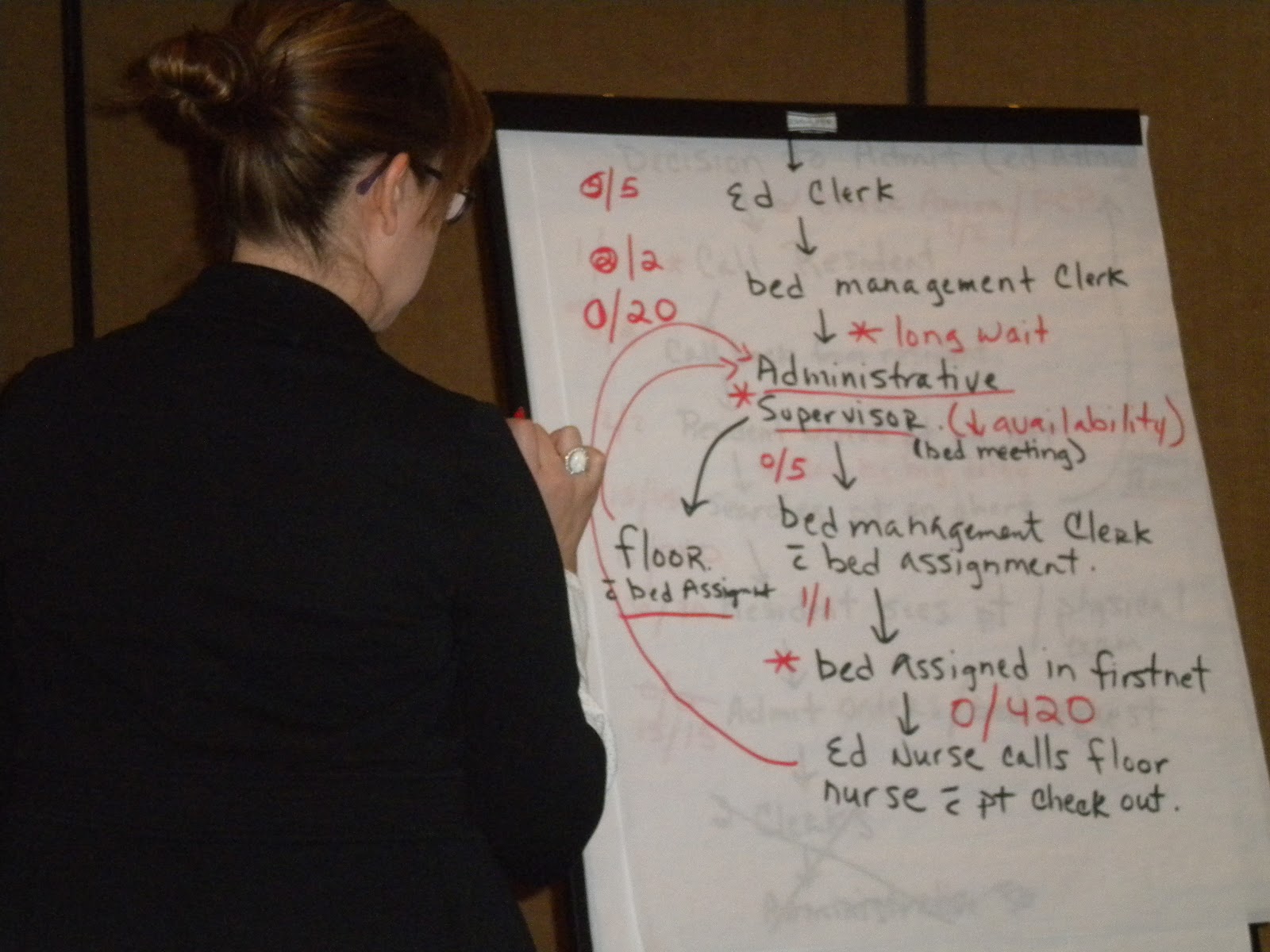
Following Dr. Kaplan's talk, UNM the residents retreat broke into work groups.  I attended the one about emergency department patient flow.  The UNM hospital handles 90,000 emergency room visits per year but suffers from major congestion problems.  The number of hours of boarding patients as they await rooms on the medical floors has grown, and there are also a substantial number of patients (14%) who leave without being seen because of the waiting times.  This is not an unusual problem in American hospitals, particularly the safety net hospitals, which face financial limitations in increasing capacity.

As we all know from our Lean training, though, there are process improvements that can be made in virtually any setting.  The purpose of our work group was to introduce residents to some of the Lean concepts.  We focused in this session on sketching out a process flow diagram, or map, indicating the steps taken in caring for a patient.  The idea is to identify all the steps and then determine the amount of time required to carry out each step.  Two metrics are used:  The net time is the actual time taken in carrying out a step; and the gross time is the fully elapsed time within which the task is accomplished, including all delays, re-work, and the like.  In most organizations, the net time is a small fraction of the gross time.

Here you see chief psychiatric resident Peggy Rodriguez keeping track as the group outlined the steps between when a decision is made to admit a patient and his or her arrival on a medical floor.  Each discrete step is itemized, and two numbers are assigned.  The one on the left is the net time for the task, and the one on the right is the gross time.

Were we doing this for real, all participants in the ED process would be engaged in creating this process flow diagram.  As the University of Michigan's Jack Billi would remind us, when a map is constructed to enable all to all aspects of the value stream, "it's not the map that's valuable.  It the process of mapping, which produces a shared understanding of the value stream and which enables the front-line team to design improvement experiments together."

This map, though, was being set forth for instructional purposes,  next you see Dr. Marc-David Munk, one of the leaders of the session, reading off the summary chart.  Peggy kept track and prepared the following summary chart.  Our rough analysis -- just based on perceptions of people in the room -- yielded 853 minutes of gross time spent per patient for work that had a value of 71 minutes.  This is remarkably close to the 14 hour average delay that the ED has documented.  The next step, if we were actually doing this in the hospital, would be to identify measures that could be taken to redesign the work flow and conduct experiments to see what would be helpful in extracting waste out of this overall process.


Dr. Kaplan addresses GME patient safety retreat in New Mexico

I am in Albuquerque, New Mexico, for a series of events related to patient quality and safety and process improvement in hospitals.  We are starting this morning with a graduate medical education retreat  entitled "Residents and Patient Safety" being run by the University of New Mexico School of Medicine.

The keynote speaker is Dr. Jay Kaplan, who practices emergency medicine in northern California and also works with hospitals throughout the country on clinical improvement matters.  I'll try to summarize key points as he talks.  His theme is "Driving Hospital Quality."

In his introductory moments, Jay noted that a rule of his department is bedside change of shift report.  He presented a recent example from his own last shift of such a handoff to show that this protocol can help identify a patient's problems that would otherwise be missed.

His major point is that customer service and quality of care are intimately related.  Quality is often viewed as the "hard stuff," while service excellence is viewed as "fluff stuff."  This is not accurate and misses the degree to which the latter affects clinical outcomes.  Quality gets you in the game; service lets you win.

One obstacle is that doctors have not been trained to be team players.  They need to learn how to collaborate.  Trained as craftsman, likewise, they are often not conversant in process improvement.

We have to focus on both systems and people.  We need people to buy into well designed systems.  Likewise, though, systems have to be designed to support great people.

Efficient patient flow requires aligned behaviors and cooperation between emergency departments and inpatient floors.

He asks the residents to ask themselves, "What do you do every day to bring quality and patient safety to your patients?"  Integrate service provision into this question.

Think bakery.  What does a customer notice upon entering?  The smell.  Do bakers notice it?  No, because they are used to it.  The analogy is:  When people first walk into your practice, clinic, or hospital, what do they notice?  What patients see, feel, and hear is different from what you and I see see, feel, and hear.  We are used to the environment.  They are not.  View your workplace from the point of view of the patients.

Here are some ideas.  Take a fresh look:  Change the signs.  Sit down when talking with patients, so they don't think you are in a hurry.  People will not hear all of your words:  Use key words that will be remembered.  As you pause to wash your hands, mention that you are doing so for their safety.  At the end of the visit, ask "What questions do you have for me?" instead of "Do you have any questions for me?"  They will always say, "No," to the latter.

Here is another set of ideas, based on the acronym ICARE:  Introduce yourself and Inspire confidence in the patient; Connect with the patient and family; Acknowledge what the patient has said; Review the plan of care and how long the various stages will take; Educate about what to expect and Ensure their understanding.

Another key strategy is to have follow-up phone calls to check on adverse reactions from drugs, to check on patient understanding, the patient's condition, etc.  This will also increase customer satisfaction.  The average time it takes to do this is two minutes and will result in some of the most rewarding feedback you will get from patients.

Tuesday, February 21, 2012

Reverse the expectation of punishment

An article in amednews.com reports:

[D]ata released in February by the Agency for Healthcare Research and Quality show that most physicians, nurses, pharmacists and other health professionals working in hospitals believe their organizations are still more interested in punishing missteps and enforcing hierarchy than in encouraging open communication and using adverse-event reports to learn what's gone wrong.

These findings underlie the tragedy in medicine that results in thousands of preventable hospitals deaths each year and untold harm to other patients. Correcting this problem is a matter of leadership, plain and simple.  The clinical and administrative leaders of hospitals need to set a different standard.


You can see this philosophy in action through an event that happened at Beth Israel Deaconess Medical Center in July of 2008. A patient woke up after orthopaedic surgery and asked her doctor, “Why is the bandage on my right ankle instead of my left ankle?” It was at that moment that the surgeon realized he had operated on the wrong limb. It is impossible to know who was more distraught, the patient or the doctor who realized that he had violated a life-long oath to “do no harm.”

It was quite clear that the hospital’s “time-out” protocol, which was designed to avoid precisely this kind of error, had not been properly carried out. In the weeks following this disclosure, a number of people asked me if we intended to punish the surgeon in charge of the case, as well as others in the OR who had not adhered to that procedure. Some were surprised by my answer, which was, “No.”

I felt that those involved had been punished enough by the searing experience of the event. They were devastated by their error and by the realization that they had participated in an event that unnecessarily hurt a patient. Further, the surgeon immediately reported the error to his chief and to me and took all appropriate actions to disclose and apologize to the patient. He also participated openly and honestly in the case review.

. . . [A] wise comment by a colleague made me realize that I was over-emphasizing the wrong point (i.e., the doctor’s sense of regret) and not clearly enunciating the full reason for my conclusion. The head of our faculty practice put it better than I had, “If our goal is to reduce the likelihood of this kind of error in the future, the probability of achieving that is much greater if these staff members are not punished than if they are.”

I think he was exactly right, and I believe this is the heart of the logic shared by our chiefs of service during their review of the case. Punishment in this situation was more likely to contribute to a culture of hiding errors rather than admitting them. And it was only by nurturing a culture in which people freely disclose errors that the hospital as a whole could focus on the human and systemic determinants of those errors.